
Every so often, a piece of music arrives with a simple question: what happens when “nothing” is the note? That’s exactly what people explore when they hear 4’33” (often called “four minutes and thirty-three seconds”)—the famous work by John Cage that challenges what listeners think of as “real” music. In this post, we’ll unpack how the idea of a “silent” song can still come with sheet music, why it’s more than an experiment, and what readers can expect to learn from the visuals and resources linked below.
How Sheet Music Can Tell You to Listen

At first glance, a “comprehensive guide” can sound like it’s only about theory—but for works like 4’33”, guides matter because the score doesn’t provide traditional pitches or rhythms in the usual way. Instead, the notation helps you understand the structure of the performance: when to begin listening, when to “change sections,” and how the audience’s environment becomes part of the composition. In other words, sheet music can still be essential even when the performer’s instructions seem minimal. The score becomes a map for attention: it frames silence so that everyday sound—room noise, page turns, distant movement—emerges as the musical material.
When “Silent” Performance Becomes a Musical Event

Some readers approach silent compositions from a thematic angle—how meaning, interpretation, and context can shape what silence “says.” While 4’33” is not a religious or moral text, people often connect it to broader human questions: patience, expectation, and the way we search for significance. A title like A Silent Song hints at a poetic lens—suggesting that even when sound is absent by intention, the “song” may exist as presence, duration, and awareness. For listeners, the result can feel like a ritual: the performance asks you to stop looking for a melody and start noticing your own sensory experience.
Understanding “Silent Night” vs. Silence as a Concept

“Silence” can mean different things depending on the music you’re comparing it to. Silent Night, for instance, is a familiar traditional hymn—but its “silence” is lyrical and metaphorical, not a performance instruction. A helpful way to think about 4’33” is that it literalizes the idea: instead of singing about quietness, the work creates a situation where quietness is actively composed. This comparison helps readers understand the difference between the meaning of silence in lyrics and silence as form. When you separate those ideas, the impact of Cage’s approach becomes clearer: it’s not that there’s “no music,” but that the definition of music shifts.
Finding Chords and Sheets for Quiet Listening Lessons
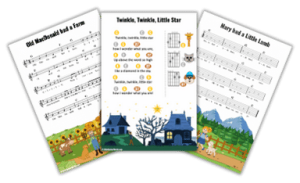
For younger musicians and beginners, the path to understanding 4’33” can begin with simpler listening activities. Music education resources that emphasize early rhythm, repetition, and accessible notation remind us that learning to hear is as important as learning to play. While 4’33” won’t teach guitar chords, it can teach something foundational: how to listen closely. Readers can expect takeaways about attention, contrast, and the idea that musical skill includes knowing what to notice in a soundscape—especially when the “expected” notes are withheld.
Cover Artwork: The Visual Invitation to a Different Kind of Score

Artwork and cover designs often do more than decorate; they set expectations for interpretation. In the case of a “Silent Song,” the visual identity can frame the experience as reflective, immersive, and open-ended. For readers exploring 4’33”, this is a key part of the journey: the “sheet music” is not just instructions for musicians—it’s an invitation for audiences to participate mentally. Even without overt melodies, the structure still matters: durations, timing cues, and performance etiquette all shape what listeners hear. Ultimately, 4’33” shows that the score can guide you toward the sounds you normally ignore—turning silence into a form you can read, follow, and experience.
If you are searching about A Silent Song Guide | PDF you’ve came to the right web. We have 10 Pictures about A Silent Song Guide | PDF like A Silent Song | PDF | Jesus | Prostitution, Silent Song | C4TM and also Silent Song | C4TM. Here it is:
A Silent Song Guide | PDF

www.scribd.com
A Silent Song Guide | PDF
Silent Night – Chords, Tabs And Sheet Music – KidsPlayMusic
www.kidsplaymusic.com
Silent Night – Chords, Tabs and Sheet Music – KidsPlayMusic
Silent Night On Piano, Guitar And Ukulele — Songs Explained Xmas
chordify.net
Silent Night on piano, guitar and ukulele — Songs explained Xmas
A Silent Song: Comprehensive Guide | PDF
www.scribd.com
A Silent Song: Comprehensive Guide | PDF
A Silent Song Guide | PDF

www.scribd.com
A Silent Song Guide | PDF
A Silent Song | PDF | Jesus | Prostitution
www.scribd.com
A Silent Song | PDF | Jesus | Prostitution
A Silent Song Guide | PDF

www.scribd.com
A Silent Song Guide | PDF
A Silent Song Qns | PDF | Logic

www.scribd.com
A Silent Song Qns | PDF | Logic
Drama『silent』 – 『silent』BGM (★★☆☆☆☆) Sheets By Soup-majo
www.mymusicsheet.com
Drama『silent』 – 『silent』BGM (★★☆☆☆☆) Sheets by soup-majo
Silent Song | C4TM
chaos4themasses.com
Silent Song | C4TM

